Cohesity · AI Sales Enablement Intern
AI Prompt Library
I was asked why sellers weren't using AI. The real answer: using it had quietly become a second job.
Interactive prototype ↗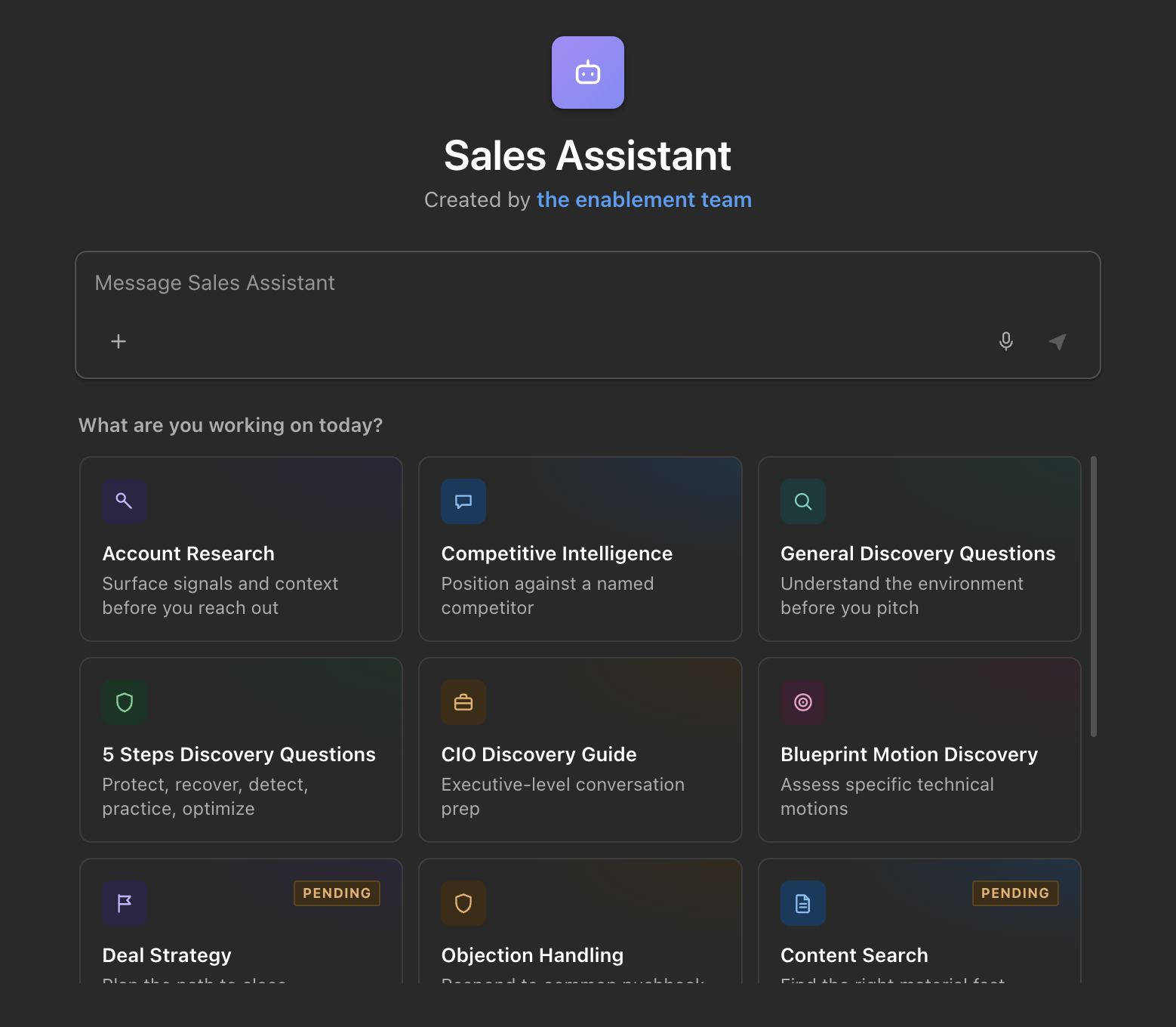
The problem
One AI assistant. Underused, not unwanted.
Cohesity built a single retrieval assistant to save sellers from digging through an overwhelming pile of sales content scattered across third-party systems, reachable from three places sellers already worked: Slack, Microsoft Copilot, and Claude. Across all three, sellers were using a fraction of what it could actually do.
The working theory was that sellers simply didn't know what the tool could do, which pointed toward a training fix. Here's what a seller's actual path looked like instead:
- Open the assistant to get an answer fast
- Land on a blank box, or ten unlabeled prompts
- Not sure what to type, or which prompt does what
- Give up, draft it themselves somewhere else
- Paste it in just to get a reply
- Or abandon it completely and retrieve the information manually
Two tools doing the job of one. Before building anything, I needed to know if the training theory was even right.
The research
Nine interviews. Six roles. Zero assumptions.
I ran these interviews because I needed to understand who I was actually building for: what their workflow looked like day to day, and where this would even fit into it, without assuming any of that going in.
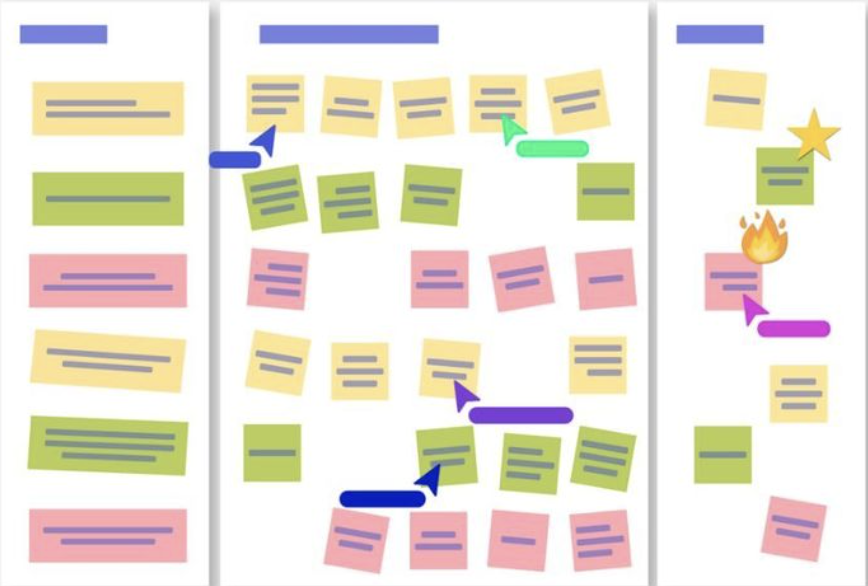
Semi-structured interviews, 30 to 45 minutes each, across Inside Sales, Renewals, SDR (×2), Sales Engineer (×3), Solutions Architect, and Public-sector AE, deliberately mixing sellers who used the assistant daily with sellers who'd tried it and stopped. Before asking a single question about AI, I counted the tools each person named unprompted for an ordinary day.
Fifteen to sixteen systems, on an ordinary day, including three separate logins for the same underlying assistant. AI wasn't a tool sellers were missing. It was one more layer inside a day that was already fragmented.
The strongest evidence
Not a wish list. Working proof.
Where the official tools didn't reach, the sharpest sellers had quietly built their own.
Two SDRs independently built the same tool
An SE built the alert the platform never sent
One rep filmed his own workday to find the waste
Synthesis
Eight distinct problems. Not one blurry complaint.
Running interview notes through Claude to find what repeated across all nine conversations surfaced eight distinct problems. Only one was mine to build.
| Problem | Evidence | Outcome |
|---|---|---|
| Sixteen tools, one seller | A rep's day spans CRM, content, docs, and three logins for one assistant | Routed: platform |
| Sellers building their own tools | Working prospecting and alert tools, built and maintained by one person, with no official version to replace them | Routed: product |
| Grounded tool vs. general AI | "The internal one is to pull internal information. Other than that, I'll just have my corporate edition of the other assistant up." (SDR) | Routed: platform |
| Writing that sounds like AI | "They all sing the same. How do you add a voice and a feeling and a character into those things?" (Sales Engineer) | Routed: new capability |
| Procedural knowledge missing | "I'd love it if I could ask Sales that... if I trust the answer, that would be very useful." (Sales Engineer) | Routed: content & permissions |
| Content freshness erodes trust | "New documents say yes, we can do that. Old documents say we can't." (Inside Sales Rep) | Routed: my own team, already in progress |
| Capabilities vanish, no warning | An SDR's own working motion broke when a capability was quietly removed, with no way to tell it apart from his own mistake | Routed: process change |
| Prompt discovery | Not one of nine interviewees had ever used the prompt library | Owned |
8 problems. 7 routed to named owners. 1 rolling out. The seven weren't mine to fix (platform-scale, new AI capability, content ops), so I wrote them up rather than quietly treating them as my own backlog.
The one I owned
Ten prompts. Zero clicks.
Names truncated mid-word, most hidden behind "Show more," a blank box doing the real work.
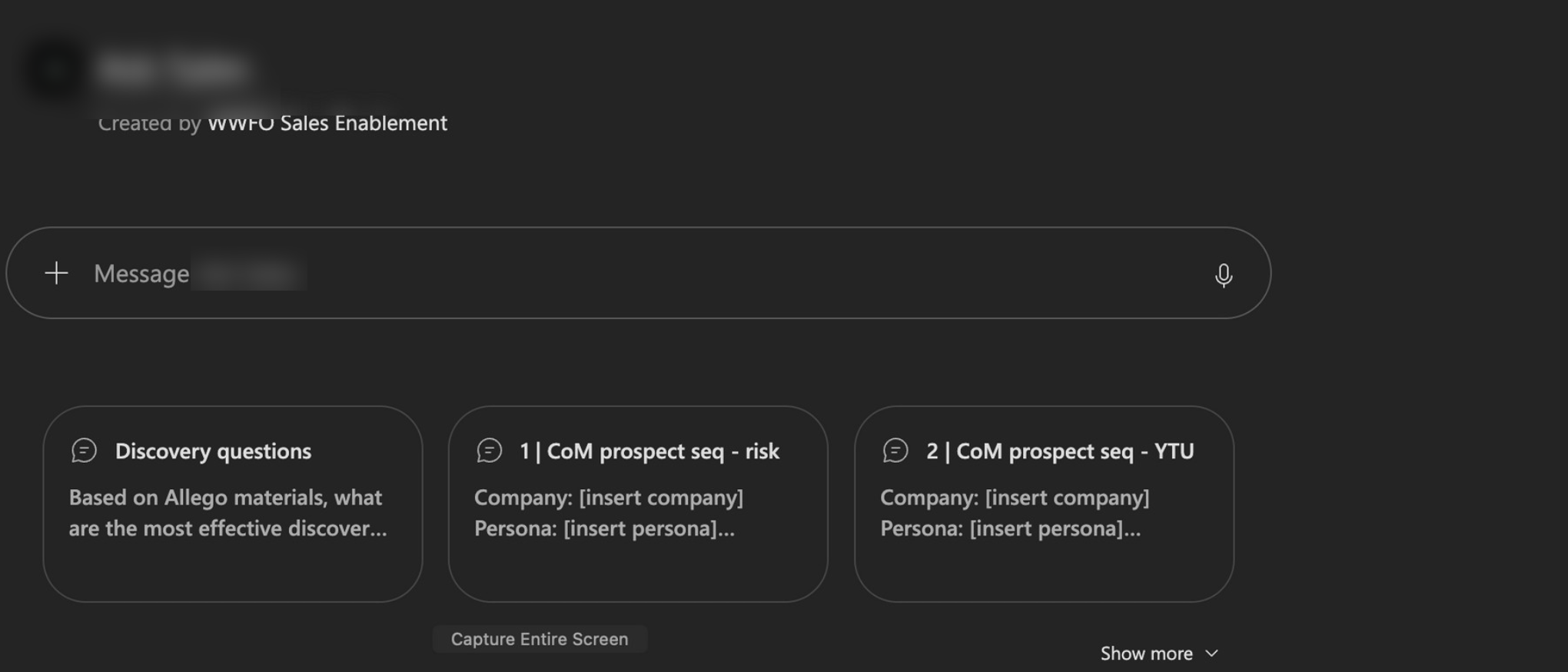
Nobody I interviewed had used it. Some hadn't even noticed it. The workaround people had settled into instead: draft the prompt somewhere else, then paste it into the assistant.
Sellers weren't bad at prompting. Prompting had quietly become a job nobody signed up for.
From sketch to shipped
One version, tested the whole way through.
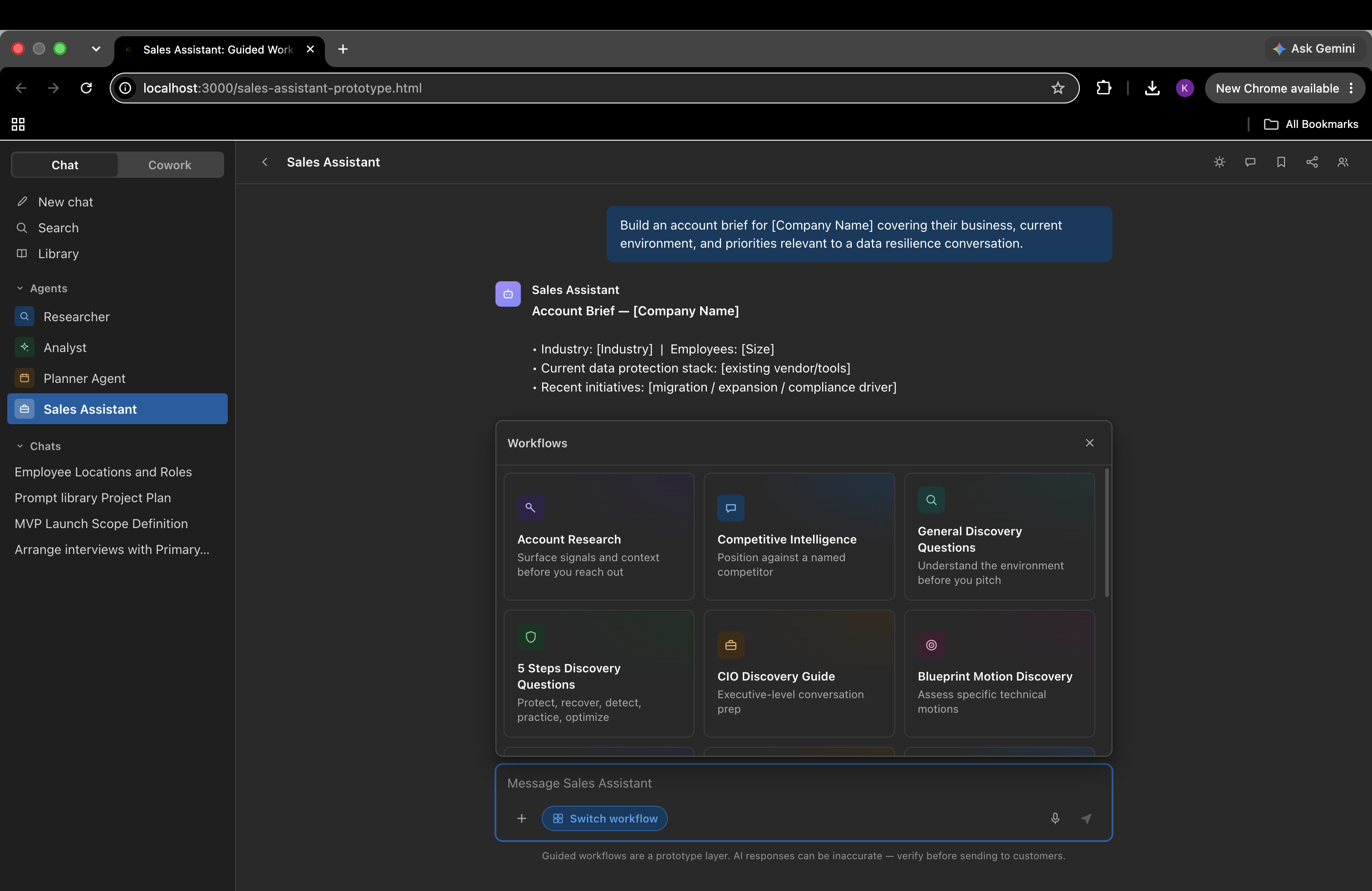
I sketched the flow on paper first: pick a card, get a prompt, send it, read the output, try another prompt in the same card. Reading it back, I caught a flaw before it reached a screen: the same two-steps-when-there-should-be-one friction the research kept turning up, rebuilt one layer down, inside the very thing meant to fix it.
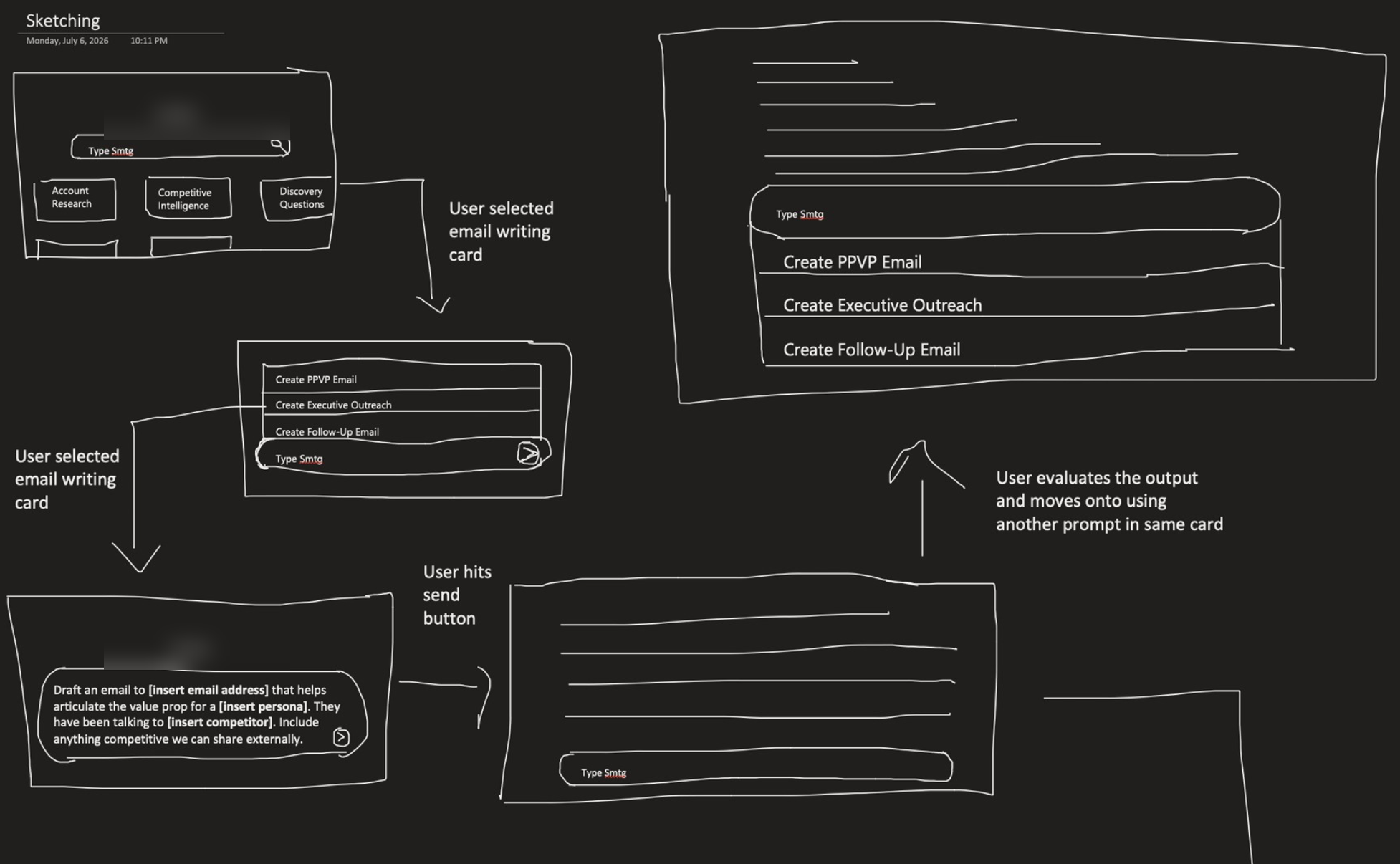
"Limitation: the user has to start a new chat when they want to switch to another card."
"Benefit: the user still has the freedom to type their own prompt, regardless of the card or option they picked."
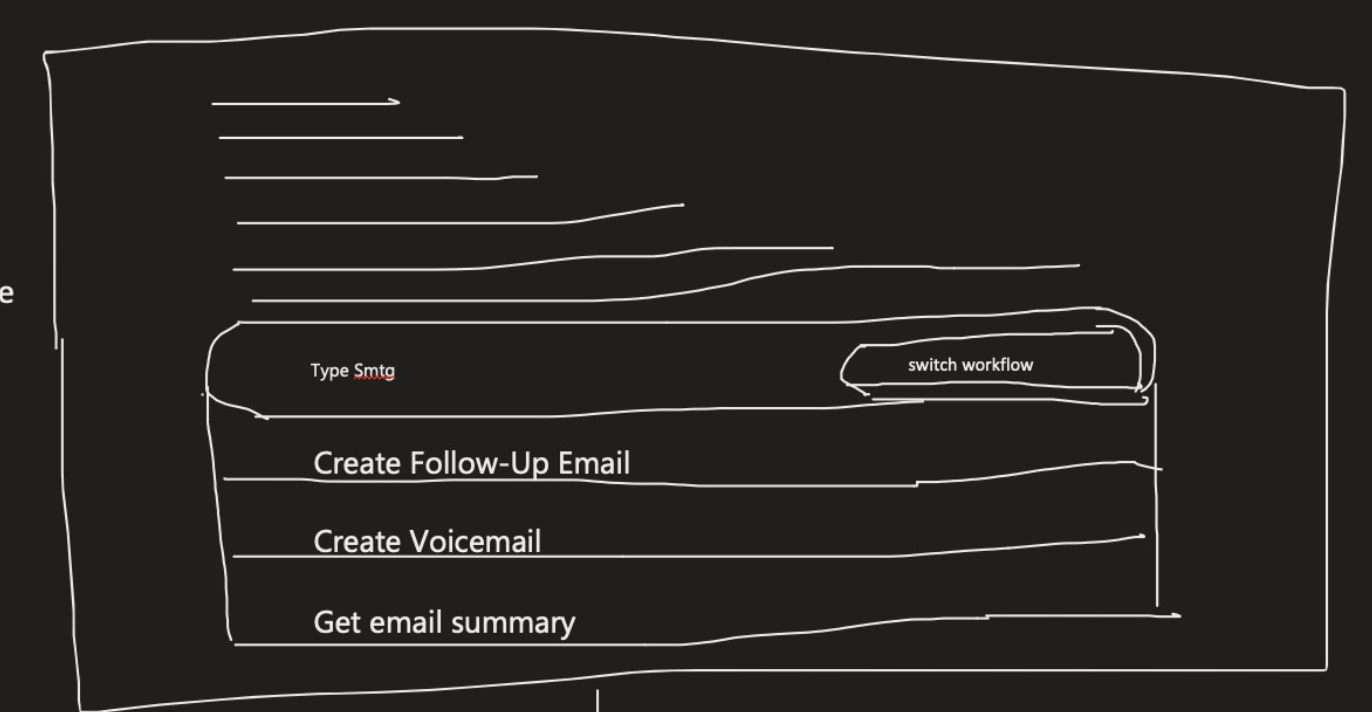
"Automatically suggest the user's possible next actions, with an option to switch cards in the same chat, through a 'switch workflow' button."
The MVP was as much about what I left out. All of this got written down and cut, on purpose:
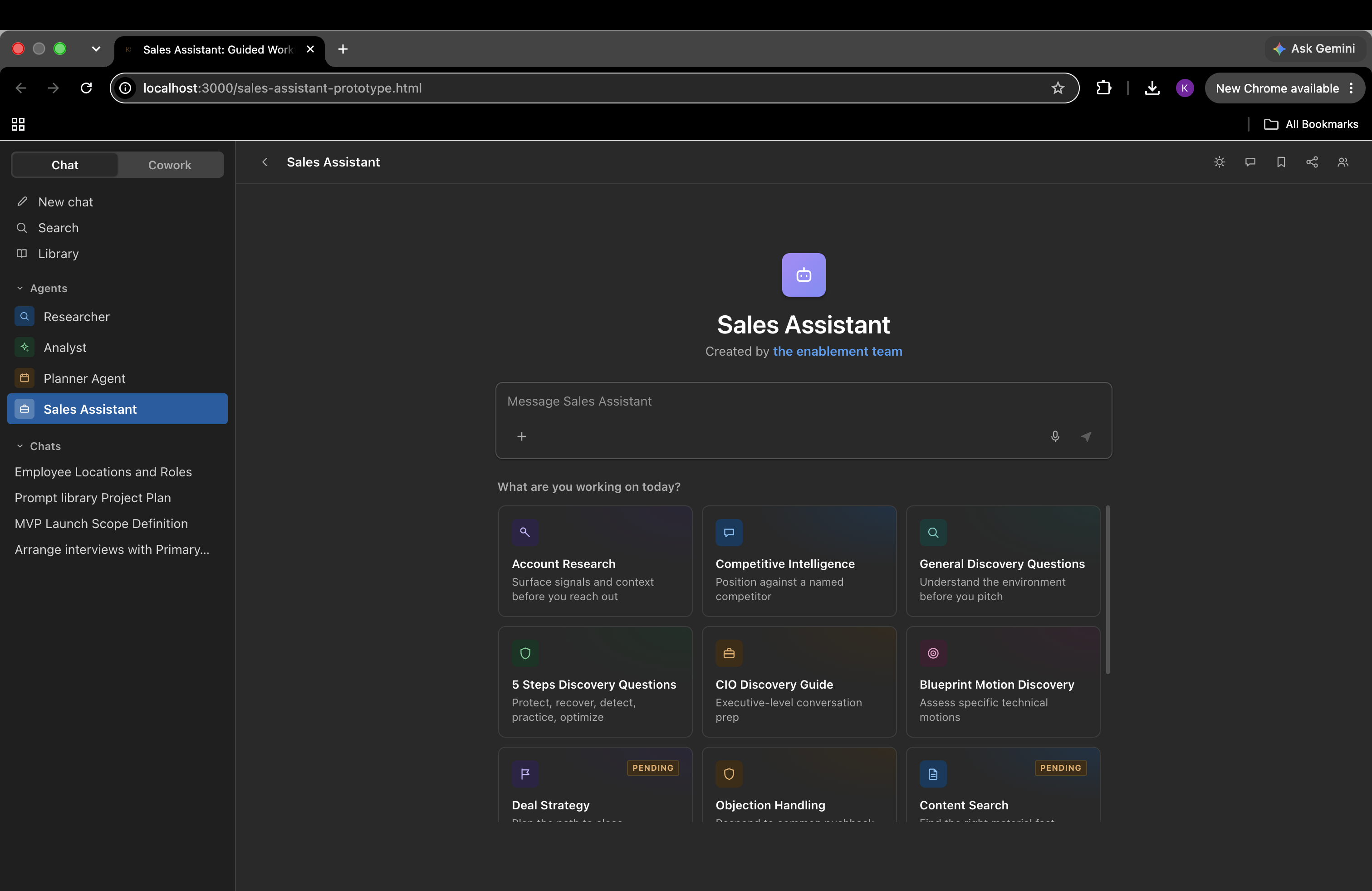
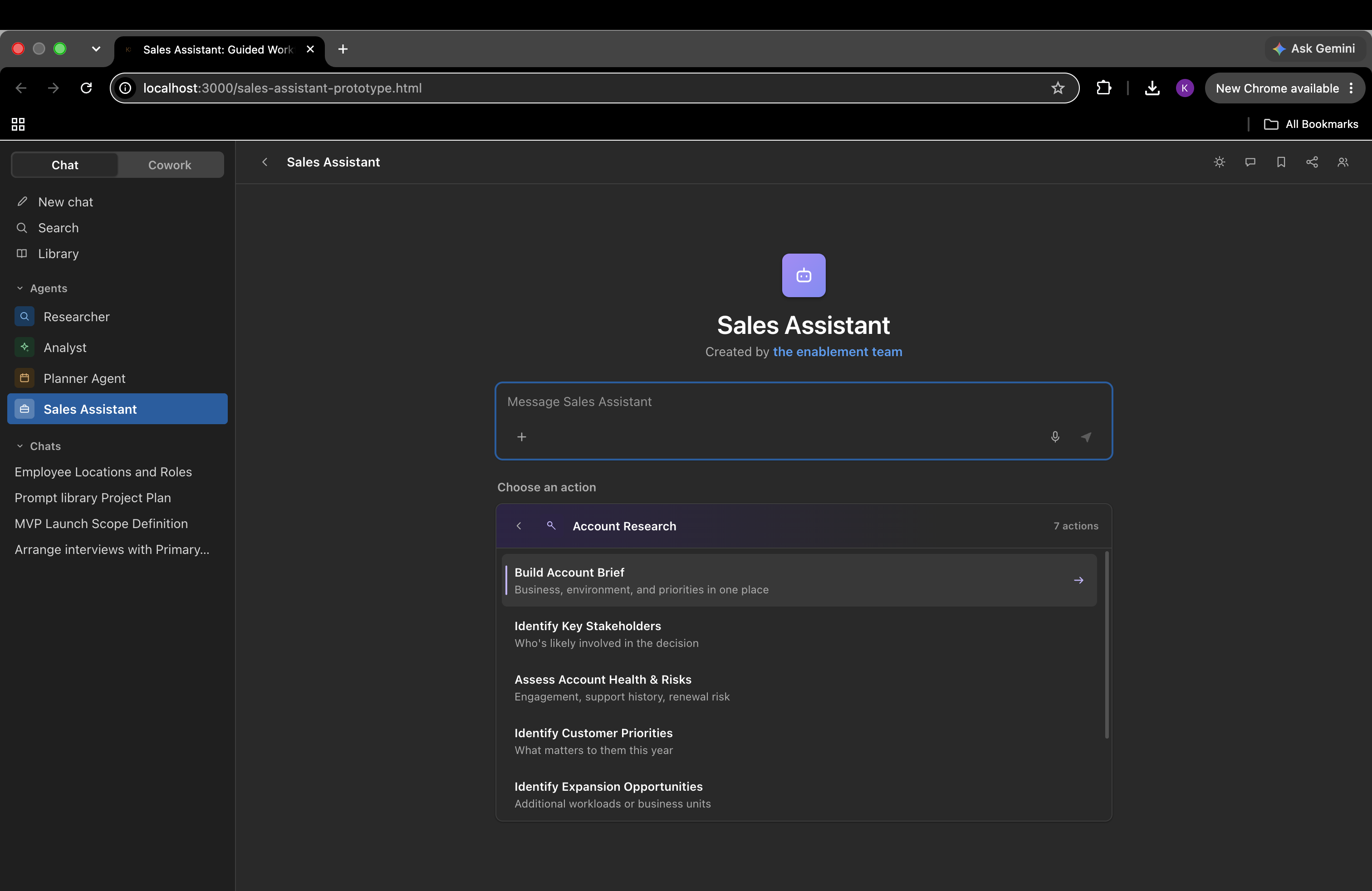
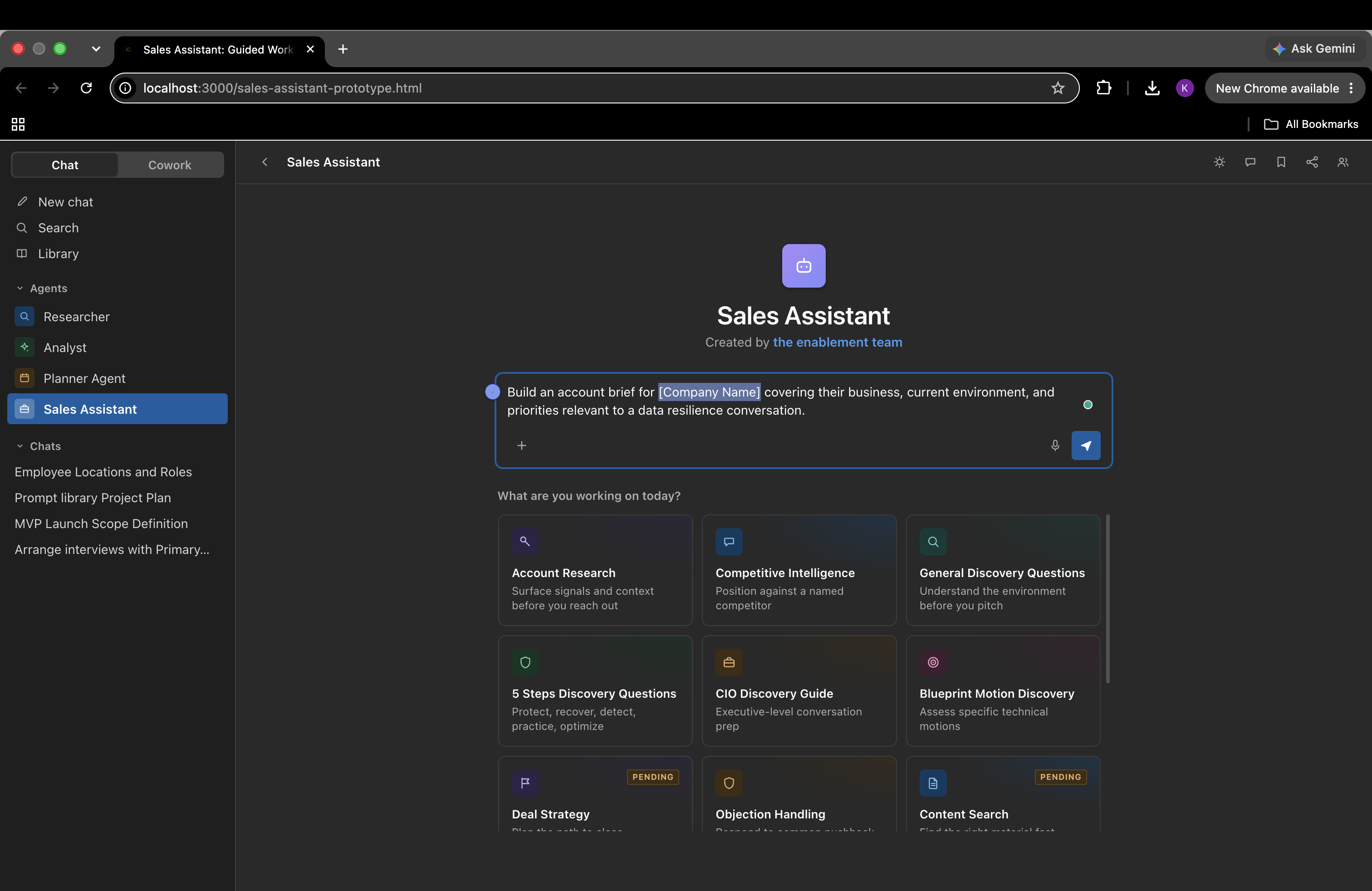
From there I tested the concept with sellers across my remaining interviews, then built the production version. I'd considered wiring directly into each surface's own API (Slack, Copilot, Claude), but the third-party owner of the retrieval system restricted key access. I chose Model Context Protocol instead, deliberately: one interface, written once, reachable from all three surfaces instead of three separate versions.
Product judgment
What I said no to.
An SDR wanted his own prompts pinned
I didn't build it. The real cost wasn't the missing backend. It was the state, storage, and data model that pinning would require, on a project about to lose its only engineer. Nobody would have been left to own that maintenance.
Sellers wanted the system to suggest what's next
Dropped: that answer differs by role, and I didn't have the usage data to guess responsibly.
A newly hired Sales Engineer wanted cards for his role only
Couldn't build it: that needed identity data the panel had no access to at the time.
"I wouldn't have known this existed."
A Solutions Architect put his finger on the biggest miss. Finding the library at all still depends on a seller already knowing it exists.
The problem
Cohesity's sellers had one AI assistant reachable from three surfaces, and used none of them well.
What we learned
Prompting wasn't a skill sellers lacked. It was work they'd been handed that wasn't their job.
What we're building
A task-framed guided library: 15 workflows, 50 prompts, sourced from sellers themselves, rolling out across all three surfaces.
The real outcome
"I didn't make sellers into prompt engineers. I made AI capabilities easier to discover, and prompting less of their job."
Rolling out now in Slack, Microsoft Copilot, and Claude: one interface, written once, replacing the blank box that nobody could use.